
How AI Agents Help Omnichannel Retailers Forecast Inventory Across Stores and Online Channels

Retail teams have used automation for years to streamline tasks like order processing, inventory updates, and reporting. But as retail operations grow more complex, many teams discover that automation alone no longer solves their biggest problems.

The real question is not whether automation works.It is whether automation is enough when retail decisions require context, judgment, and coordination across systems.
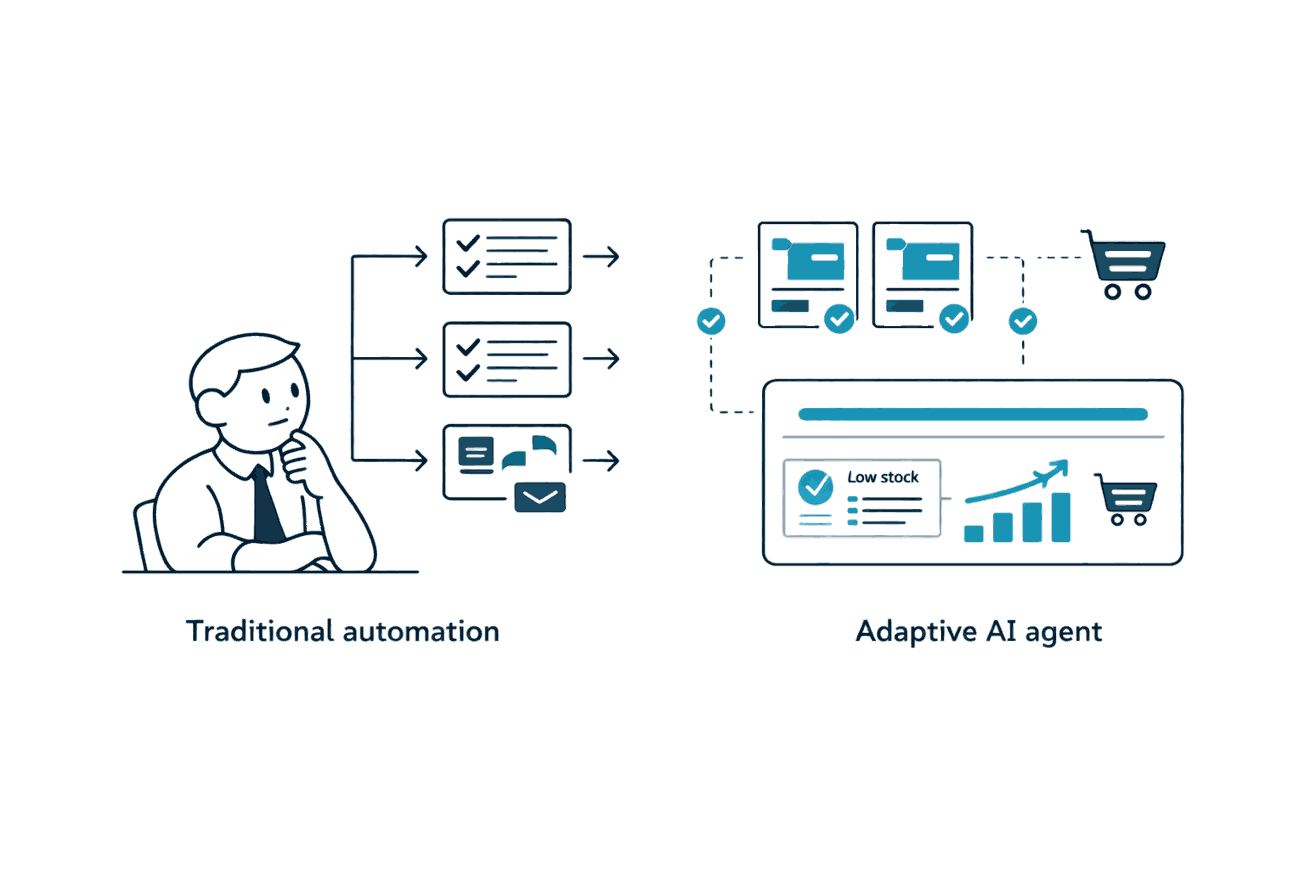
When Do Retail Businesses Need AI Agents Instead of Traditional Automation

Why omnichannel inventory forecasting breaks down

Forecasting inventory across stores and online channels is harder than single‑channel planning. Retail teams often lose accuracy because signals arrive late, conflict, or lack context.

Common challenges include:

  • Store sales and ecommerce demand tracked in separate systems
  • Promotions driving demand spikes that forecasts miss
  • Inventory showing available in one channel but unavailable in another
  • Returns and transfers distorting demand signals
  • Planners relying on exports, spreadsheets, or delayed reports

The issue is not forecasting methodology. It is the inability to reconcile what is happening across channels in real time.

When Do Retail Businesses Need AI Agents Instead of Traditional Automation

What AI agents do differently from traditional forecasting tools

Traditional forecasting tools rely on predefined models and scheduled data updates. AI agents operate at the operational layer, answering questions as conditions change.

An AI agent in an omnichannel retail context:

  • Retrieves live sales, inventory, and fulfillment data across systems
  • Understands channel‑specific context (store vs online vs fulfillment)
  • Explains changes, exceptions, and anomalies
  • Supports planners and operations teams with actionable insights

Instead of producing another forecast report, AI agents help teams understand why inventory levels look the way they do right now.

Logicon implements AI agents by integrating retail systems, defining access boundaries, and aligning agent behavior with real planning workflows.

When Do Retail Businesses Need AI Agents Instead of Traditional Automation

How AI agents support omnichannel inventory decisions

AI agents reduce forecasting blind spots by connecting demand and supply signals across channels.

In practice, AI agents help retailers:

  • Identify demand shifts between online and in‑store channels
  • Explain sudden stockouts or overstock situations
  • Surface the impact of promotions, returns, or regional demand
  • Answer questions about inventory availability by location and channel
  • Support faster replenishment and allocation decisions

For example, a planner can ask why a product is overstocked in stores but unavailable online. The AI agent checks store sell‑through, ecommerce demand, recent promotions, returns, and transfer activity before returning a clear explanation.

When Do Retail Businesses Need AI Agents Instead of Traditional Automation

Forecasting across systems, not spreadsheets

Omnichannel inventory decisions require coordination across multiple systems. AI agents work across existing tools instead of replacing them.

Typical systems connected include:

  • Point‑of‑sale systems
  • Ecommerce platforms
  • Inventory management systems
  • Order management and fulfillment tools
  • Supply chain and warehouse systems
  • Promotions and pricing platforms

All access is permission‑based, logged, and auditable.

When Do Retail Businesses Need AI Agents Instead of Traditional Automation

When omnichannel retailers benefit most from AI agents

Retailers typically consider AI agents for inventory forecasting when:

  • Forecast accuracy declines as channels increase
  • Store and online teams work from different data views
  • Promotions regularly create forecasting surprises
  • Inventory decisions depend on manual reconciliation
  • Teams spend more time explaining variances than acting on them

When forecasting becomes reactive instead of proactive, AI agents provide the missing context.

When Do Retail Businesses Need AI Agents Instead of Traditional Automation

Using AI agents for omnichannel inventory forecasting

AI agents can be deployed without disrupting existing retail infrastructure. They support planning, merchandising, and operations teams by working across approved systems and delivering consistent, explainable answers.

Logicon designs and implements AI agents for omnichannel retailers by integrating data sources, enforcing access controls, and aligning agents with real‑world inventory workflows.

See if AI agents can improve inventory forecasting across your retail channels.

When Do Retail Businesses Need AI Agents Instead of Traditional Automation

Questions ecommerce operations leaders ask

How do AI agents improve forecast accuracy?
They use live, cross-channel data to explain demand changes instead of relying solely on historical averages. By connecting real-time signals from all systems, AI agents provide context that traditional forecasting tools miss.
No. They sit on top of existing systems and help teams interpret and act on forecasting signals. AI agents enhance your current infrastructure rather than replacing it.
Yes. AI agents are designed to connect POS, ecommerce, and inventory systems seamlessly. They understand the context of each channel and can explain cross-channel dynamics.
Yes. They scale with system complexity and channel growth. Whether you have 10 stores or 1,000, AI agents adapt to your operational needs.
AI agents are usually implemented by AI engineering teams like Logicon that specialize in retail system integration, access controls, and aligning agents with real-world inventory workflows.

Final takeaway for omnichannel retail leaders

Inventory forecasting breaks down when demand spans multiple channels but insight does not. Omnichannel retailers do not fail because they lack data. They fail because signals remain fragmented.

AI agents help retail teams see demand as it actually unfolds across stores and online channels, explain why inventory is shifting, and act before small imbalances become costly problems.

For omnichannel retailers, AI agents are not about predicting the future better. They are about understanding the present clearly enough to respond in time.