
Subscribe to our newsletter
The pager beside Marco’s bed screeched at 3:17 a.m.
Pipeline 7 – his firm’s real-time fire-hose of card-transaction data – was in free-fall. By the time he joined the virtual war room, the dashboards looked like a pinball machine gone berserk. Their normally rock-solid fraud model was locking thousands of legitimate purchases while allowing obvious scams to pass through. Chaos.
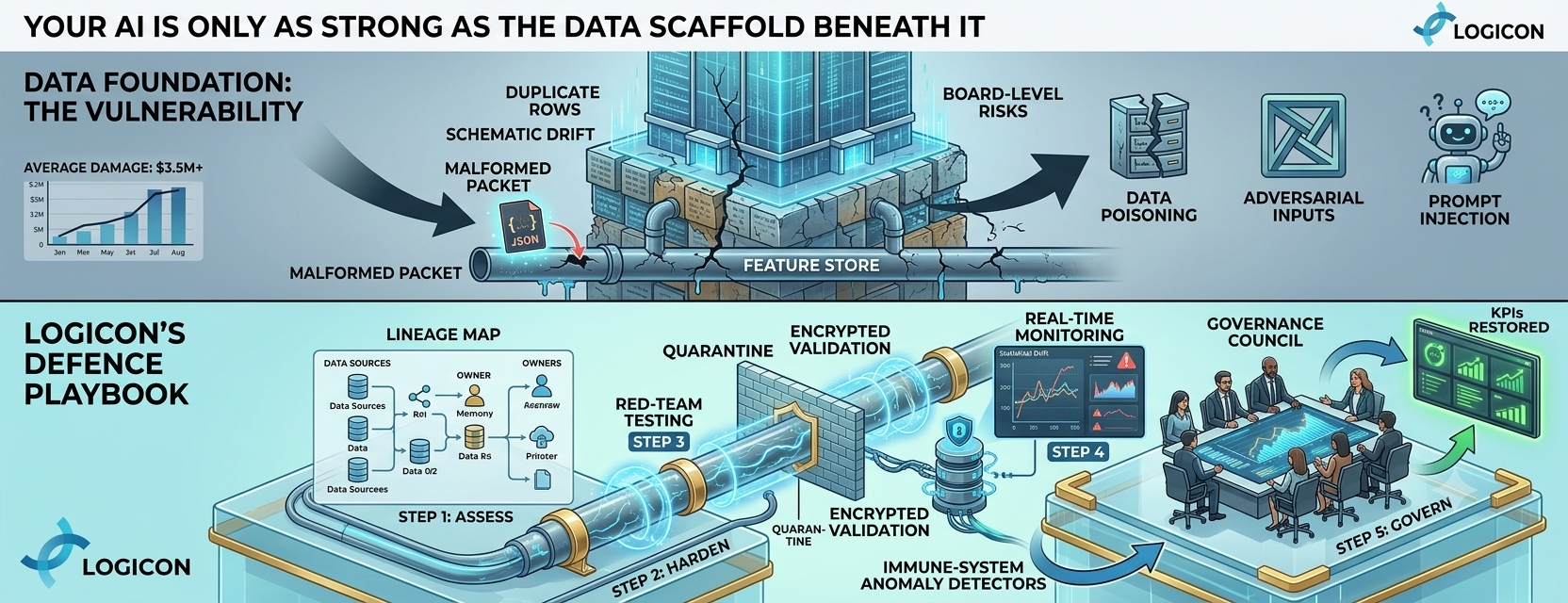
Six hours, three bleary-eyed data scientists, and a lake of burnt coffee later, they pinpointed the saboteur: one malformed JSON packet from a third-party feed that slipped past every schema check and poisoned the feature store. There was no battering-ram attack, no ransom demand just a hairline crack in the data foundation that rippled through every downstream system.
The Hidden Cost of Messy Data
Incidents like Marco’s aren’t rare flukes anymore; they’re the soundtrack to a typical Monday stand-up. We love to dramatise AI security with genius hackers and nation-states, yet the biggest failures lurk in boring, unattended corners of the data stack.
Average damage per AI-related breach now tops $3.5 million (IBM 2023). And more often than not, the villain isn’t exotic zero-day code it’s bad plumbing: duplicate rows, drifting schemas, fossilised tables—board-level risks masquerading as “technical debt.”
Anatomy of an AI Vulnerability
Attackers seldom smash an algorithm; they nudge it off course:
- Data Poisoning – Seed the training set with tainted examples until the model internalises lies.
- Adversarial Inputs – Feed the live model optical illusions that boost confidence in the wrong answer.
- Prompt Injection – Hide instructions inside a seemingly harmless user prompt, bending an LLM to the attacker’s will.
Buzzword → Plain English
- Data Poisoning = spiking the pantry
- Adversarial Attack = showing the AI an impossible picture
- Prompt Injection = Jedi mind-tricking the chatbot
Why 78 % of Weak Spots Live in the Data Layer?
A Berkeley–MILA study found that four out of five AI failures were attributed to data quality not model code. The soft underbelly lies in the classic “DQ” quartet:
| Data-Quality Pillar | What It Really Asks | How It Fails in the Wild |
| Accuracy | Is every fact correct? | Attackers tweak geo-tags to make cross-border spending appear normal. |
| Completeness | Do we have the complete picture? | Nulls in ‘previous_medications’ become “no meds,” tanking readmission scores. |
| Consistency | Do systems agree on units & labels? | °C versus °F sensors create phantom defect patterns on the line. |
| Timeliness | Is the data fresh enough? | A 24-hour lag discounts out-of-stock SKUs, vaporising margin. |
These cracks are termites—unseen until the support beam snaps.
Structured vs. Unstructured: Different Flaws, Same Headache
Structured data fails quietly type mismatches, schema drift, rogue labels.
Unstructured data fails loudly pixel tweaks, hidden prompt strings, audio artefacts.
Either way, the CISO’s migraine is identical: the AI’s judgment can’t be trusted, yet the detection and defence toolkits are totally different.
Pipeline Pitfalls: From Collection to Feature Engineering
Picture a marketing ETL stream:
- Collect – Dozen-plus sources, including an unvetted data broker that slips in thousands of slightly “puffed” income fields.
- Transform – Feature engineering can multiply the lie; purchasing power appears sky-high for one ZIP code.
- Load – The tainted set trains the model. Twelve months later, a crime ring targets that wealthy-looking ZIP and the AI, now unwitting accomplice, hands them segmentation on a platter.
Red Flags in Your Pipeline
- Collection: No source attestation; blind trust in vendors
- Transformation: Anomaly checks limited to ±3 σ; complex logic goes unchecked
- Loading: No final drift test before data reaches training land
This entire vulnerability was automated before a single human blinked.
Mini-Profiles from the Trenches
The Bank — When a new loan-approval model began red-lining an entire demographic, the data-science team combed the code for bias. The smoking gun turned out to be mundane: thousands of applications with half-filled street-address fields. A two-week, round-the-clock data-cleansing and imputation sprint fixed the issue no algorithmic surgery required.
The Hospital — A silent firmware patch for the MRI scanner nudged the scan resolution from 512 × 512 to 520 × 520 pixels. The vision network, trained on the old format, started hallucinating tumours. Engineers retrained the model on mixed-resolution images and added a checksum gate that blocks scans with unexpected headers.
The Automaker — A supplier’s flaky API dribbled malformed JSON into the parts-forecast stream; nulls were read as zeros, and the system ordered truckloads of the wrong bearings. “They never breached us,” the CISO said. “They poisoned the well we drink from.” A new signature-validation wall and aggressive rate-limiting now isolate all external feeds.
A Six-Step Defence Playbook
| Step | Timeframe | What to Do |
| 1 — Assess | Weeks 1-4 | Inventory every data ingress, transformation, storage bucket, and model consumer; build a living lineage map with owners, SLA, and escalation paths. |
| 2 — Harden | Weeks 5-12 | Lock schemas, apply cryptographic fingerprints to incoming batches, quarantine third-party feeds until they pass automated and human review, and establish break-glass rollback scripts for every pipeline. |
| 3 — Test | Ongoing | Red-team with adversarial examples and staged poisoning; better to find the holes yourself. |
| 4 — Monitor | Real-time | Alert on statistical drift before KPIs crater. |
| 5 — Govern | Quarterly | The cross-functional council is responsible for policy, budget, and accountability. |
| 6 — Improve | Always | Feed lessons back; today’s defence becomes tomorrow’s baseline. |
The Future Threat Horizon
Next-generation “generative adversaries” will deploy AI to hunt AI, probing datasets for weak assumptions and synthesising tailor-made poison. Today, nation-states already view data-layer tampering as a form of covert economic warfare. The countermeasures cryptographic provenance chains and always-on “immune-system” anomaly detectors can work, but only for organisations that design for resilience instead of clinging to perimeter-only defenses.
Closing Reflection
When Marco finally stepped into the sunrise, the dashboards glowed green, yet he knew the battle had just begun. The breach wasn’t a Hollywood cyber-raid; it was a slow haemorrhage of a thousand tiny shortcuts—a culture that prized shipping speed over structural soundness. They had raised a gleaming tech skyscraper on waterlogged soil.
Your AI is only as strong as the data scaffold beneath it. Patch the scaffold, or watch the marvel collapse.
Ready to stress-test your own foundations? Book a complimentary benchmark session with Logicon’s specialists.